Tuesday, July 12, 2011

Metal Report: Tin

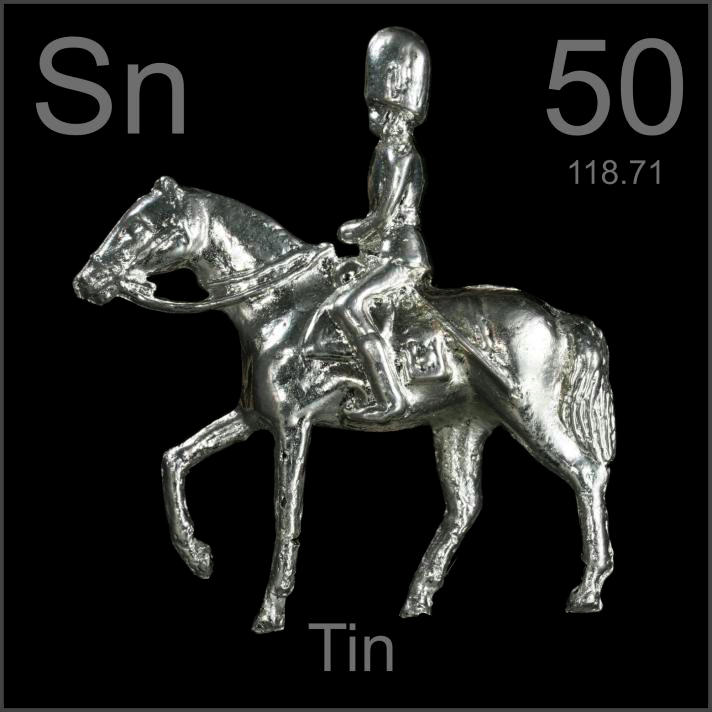
Tin:

Protons: 50
Neutrons: 69
Electrons: 50
Atomic Mass: 119
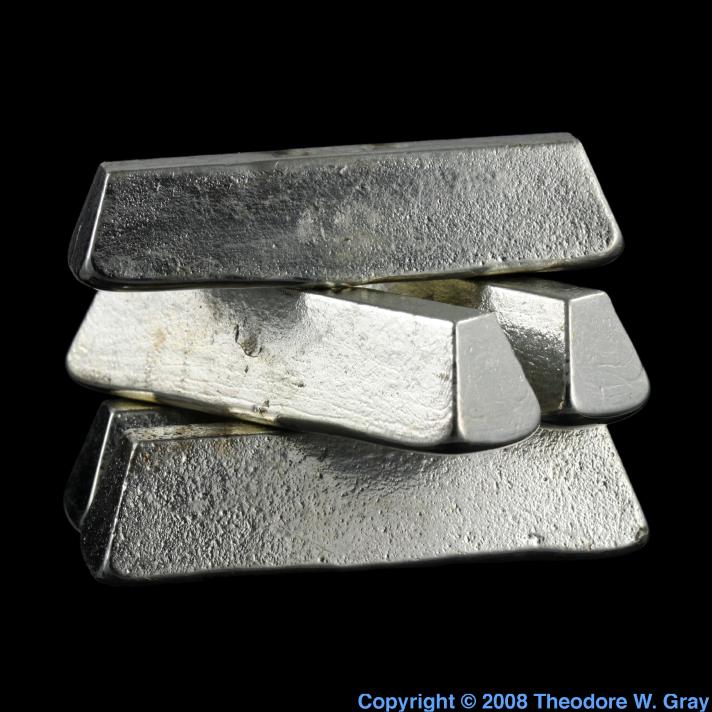
History: Tin use can be dated back to the Bronze Age (around 3000 BC), since it used in the production of bronze with copper. The earliest evidence of tin mining is from Europe, in Brittany, Cornwall, Devon, and the Iberian Peninsula. The demand for tin reached a high during the Classical times, but then decreased during the Medieval period. Cornwall was the major tin producer during the Middle Ages, however that changed after large tin deposits were found in Bolivia and East Asia. In 1956 tin producers formed the International Tin Council to regulate the production of tin. Tin was once used to wrap food and drugs, but was replaced by aluminum foil (hence the term “tin foil”). Although many items are called “tin” they are now actually used with steel or aluminum.
Characteristics: Tin is a silvery white metal that has a distorted diamond structure. It combines well with iron, and has 10 stable isotopes. In nature, it is rarely found free but as tin dioxide with mineral cassiterate. Tin can be reduced with coal. It does not appear to be an expensive metal, and its replacements could be due to a lack of it. It is found and mined mainly in Chinas, Malaysia, and Peru, in descending order. Tin also produces plenty of isotopes: bronze, pewter, solder (the most common use of tin), and spotted metal which is made when tin combines with lead but lead cools faster giving the metal a dappled effect. 

Properties: It is very soft and malleable, and is not easily oxidized. For this reason it is used to cot other metals to prevent corrosion. It has a melting point of 232°C, and a boiling point of 2270°C.
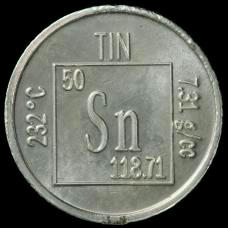

Uses: Tin is not toxic, so it is used in food packaging. Tin salts, which are toxic, are used to spray on glass for electrically conductive coatings. Molten is used to help produce float glass, which is used in windows. The most common tin salt, stannous fluoride, is used in toothpaste. Tin chloride is used in dying textiles and increasing the weight of silk. Also, tin replaces lead in some fishing weights.


Tin Cycle:
 0001292814-10-001853_X27X0.JPG.jpg
Sources:


Sunday, July 10, 2011

Unit 2: Section B summary: 9-22 p. 151-2


9.    Active metals are more difficult to process and refine because they will be harder to separate from their compounds.
10.Copper and silver would be the easiest to process because they are the least reactive out of the four metals we investigated.
11.Most metals exist as minerals rather than pure metallic elements because most of them are very reactive.
12.Calcium will react with chromium chloride, rather than the other way around because in general a more reactive metallic element will react with a less reactive element.
13. The (a) equation will most likely occur because a more reactive element will cause the ions of the less reactive element to change to their corresponding metal.
14.
a.    That would be a poor idea because iron is more reactive than lead, which means the iron metal of the spoon will corrode or dissolve.
b.    Pb2+(aq) + Fe(s) à Pb+(aq) + Fe+(s)
15. Reduction is a chemical change in which a reactant can be considered to gain one or more electrons. Oxidation is a chemical change where a reactant loses one or more electrons.
16. Equations:
a.    Ag3+ + 3e- à Ag
b.    Và V4+ + 4e-
c.    Cu+ à Cu2+ + e-
17.   Oxidation or Reduction:
a.    Reduction
b.    Oxidation
c.    Reduction
18. Zn(s) + Ni2+(aq) à Zn2+(aq) + Ni(s)
a.    Zinc has been oxidized because it has lost electrons.
b.    Nickel has been reduced because it gained electrons.
c.    The reducing agent is the zinc.
19. 2 K(s) + Hg2+(aq) à 2 K+(aq) + Hg(s)
a.    Potassium has been oxidized because it lost an electron.
b.    Mercury has been reduced because it gained electrons.
c.    Mercury.
20.  More Equations:
a.    Al(s) + Cr3+(aq) à Al3+(aq) + Cr(s)
b.    Mn2+(aq) + Mg(s) à Mn(s) + Mg2+(aq)
21.
a.    Electrometallurgy uses an electrical current to supply electrons to metal ions, thus reducing them.
b.    Pyrometallurgy involves the treating of metals and their pres with heat, as in a blast furnace. The reducing agents, such as carbon and carbon monoxide, provide electrons thus causing the metal ions to be reduced.
c.    Hydrometallurgy is the treating of ores and other metal-containing materials with reactants in a water solution.
22.
a.    With magnesium it is most helpful to use electrometallurgy,
b.    For lead, pyrometallurgy is most useful.


Thursday, July 7, 2011

Extra Credit Summary: Mental Well-being


   You may have realized that there are some differences between city slickers and country folk, but do their minds actually work differently? Can where you live affect your stress level? In the article, “A New York State of Mind” from the Economist, research studies show that people living in the city are overall more stressed than those in rural areas. The article says that city dwellers have a higher chance of developing anxiety and mood disorders. A study down by Dr. Meyer Lindenberg provides some evidence for this. To do so he performed tests on several subjects from different areas while recording the activity of their amygdalas and pACC. The amygdalas are a pair of structures found deep inside the brain that assess threats and generate the emotion of fear. The pACC or perigenual anterior cingulated cortex is the part of the brain that regulates the amygdalas. While amygdalas respond to situations here and now, the pACC is set early on and is not flexible. This means that the activity in one’s pACC is not determined by where they live now, but where they grew up. In his first test, Dr. Meyer had the subjects take tests that they were supposed to fail, but added elements that made the experience more embarrassing while indicators of stress were recorded by a scanner. Results showed that the amygdalas of the city-dwellers were the highest, while those of country people were lowest. However, because of the nature of the pACC, the activity level varied since it depends on where the subject was brought up. Several other stress tests where performed to double-check these findings, and stress-free experiments were done as well. This is odd because living in the city seems like it should be less stressful since it provides luxuries. However, the hustle and bustle of city life probably does create some stress problems. Perhaps living in the countryside provides the most relaxing setting for your mind and your brain.

Section A Summary:26-34 & Section B Summary:1-8


26. Metallic elements are more likely to lose electrons and form cations.
27. This indicates that they are hardly chemically reactive since their electrons are not attracted to any other element.
28. Anion or Cation:
a.    Na: cation
b.    Ca: cation
c.    F: anion
d.    Cu: cation
e.    O: anion
f.     Li: cation
g.    Sn: cation
h.    I: anion
29.Oxygen with mass number 16 and oxygen with mass number 18 is the more chemically similar pair. This is because only their masses are different, but they still have to same number of protons and electrons, and have the same charge.
30. The diameter of calcium should be around 205 pm.
31.Physical an chemical changes:
a.    If a substance changes color then it could have combined with another substance chemically, or its temperature changed rapidly, causing the color to change temporarily.
b.    A change in temperature could have happened because of freezing or boiling, or it could have been the result of combustion.
c.    Gases formed from a chemical change could have come from a mixture with another substance, or it could be a physical change resulting from boiling and evaporation.
32. Elements:
a.    Bromine (Br)
b.    Silicon (Si)
33.The fish-kill river data and the periodic table are similar because they were arranged periodically, or in intervals. 
34. For one example, argon and potassium would have been switched because argon’s weight (39.95) is slightly larger than potassium’s (39.10). Another example is cobalt and nickel, because Co’s weight id 58.93 while Ni’s is 58.69.


1.    In Earth’s atmosphere supplies of nitrogen and oxygen are found in 78% and 21% compositions respectively. In the hydrosphere water and many dissolved minerals are contained. Lastly, in the lithosphere, which is the solid part of the Earth, provides a variety of chemical resources such as petroleum and metal-bearing ores.
2.    Layers of the Earth:
a.    There are three major parts in the lithosphere, the crust, mantle and core. The crust is the outermost and thinnest layer of the earth where some silicates, coal, oil, natural gas, carbonates, oxides and sulfides are found. The mantle, the middle layer, contains silicates of magnesium and iron. Finally, the core is the innermost layer of Earth. It has very high temperatures and has iron and nitrogen.
b.    The crust serves as the main storehouse of chemical resources used in manufacturing consumer products.  
3.    National productivity:
a.    Mexico produces the most silver (0.1 metric tons more than Peru).
b.    Japan produces the most copper.
c.    China produces the most tin.
4.    China produces the largest masses of aluminum, copper, iron ore, lead, nickel, silver, tin, and zinc.
5.    Minerals are naturally occurring solid compounds containing the element or group of elements of interest. On the other hand, an ore is a naturally occurring rock or mineral that can be mined and from which it is profitable to extract a metal or other material.
6.    The factors determining the feasibility of mining a particular ore are:
·      The quantity of useful ore found at the site
·      The percent of metal in the ore
·      The type of mining and processing needed to extract the metal from its ore
·      The distance between the mine and metal-refining facilities and markets
·      The metal’s supply-versus-demand status
·      The environmental impact of the mining and metal processing
7.    The demand for gold might have increased so even if there is not a large percent of gold in the ores, it is economically possible to mine those ores.
8.    A “useful ore” is one that contains a high percentage of the mineral being mined, as opposed to an ore that contains 4% of the mineral.