Thursday, July 14, 2011

Unit 2: Section D Summary: 1-6


1.    An allotrope is a different form of an element that has distinctly different physical properties, but has to be in the same state as the original element (for example solid iron and molten iron have different properties but are not allotropes since one is a liquid).
2.    Oxygen and aluminum both form allotropes.
3.    Diamond, coal, and pencil lead:
a.     Diamond is a hard substance, does not conduct electricity, and is colorless. Coal is powdery and used for fuel. Graphite is black, slippery, electrically conductive, and soft.
b.    Their properties vary because of their structures.  Diamond has tightly knit bonds, while graphite’s bonds are looser, making it an ideal lubricant.
c.    The appearance, quality, usefulness, and quantity account for their costs.
4.    Engineered materials sometimes have different properties than their original substances to make them more durable and useful for a job.
5.     Ceramics can operate at high temperatures, rather than metals, and have very high melting points. However, ceramics are very brittle and can crack during rapid changes in temperature. For example, when an engine starts cooling down the ceramic will crack and could lead to engine failures.
6.    To make plastics more useful, increasing their resistance to heat would be useful. For example, accidentally placing a plastic plate on a hot surface will cause it to melt resulting in a sticky mess. Increasing their melting points would help avoid these inconveniences. Also, finding a new way to make plastics would decrease pollution and waste caused by plastic materials. Inventing a decomposable substance that is renewable would greatly please the public.


Unit 2: Section C Summary: 18-21

                                                                       (non renewable)


18. Reusing and recycling:
a.    Reusing is using items that can be refurbished or repaired, rather than sent to a landfill. Recycling is gathering certain items to be reprocessed, allowing them to be used again.
b.    Reusing: reusable water bottles and donating clothes to charity. Recycling: cardboard and tires can be recycled.
19. Renewable and nonrenewable resources:
a.    Renewable: trees, animal waste, fruits, and wind.
b.    Nonrenewable: nuclear power, minerals (copper, gold, silver), helium, and lignite (soft, brown fuel).
20. Recycling or reusing:
a.    Reusing
b.    Recycling
c.    Reusing
21. A light bulb is produced from plastics, chemicals and glass, while a newspaper contains plants and some chemicals. A newspaper can be thrown away in a trashcan, but light bulbs must be disposed of carefully taking into consideration the chemicals contained inside. The problem is the mercury, which incandescent light bulbs do not contain. When recycling, newspapers can just be shredded up and put into the cycle again, but light bulbs must be carefully taken apart.


Wednesday, July 13, 2011

Unit 2: Section C Summary: 13-17


13.  3 PbO(s) + 2 NH3(g) à 3 Pb(s) + N2(g) + 3 H2O(l)
a.    6 moles NH3
b.    5 mol N2
c.    5 mol Pb
14. 3 PbO(s) + 2 NH3(g) à 3 Pb(s) + N2(g) + 3 H2O(l)
a.    1 mol N2
b.    621 g Pb
c.    28 g N2
d.    447 g PbO
15. ?
16. Percent by mass:
a.    93% Ag
b.    53% Al
c.    40% Ca
17. A 50.0-g sample of ore contains 5.00 g lead (II) sulfatee, PbSO4:
a.    68% Pb in lead sulfate
b.    9% lead (II) sulfate in ore
c.    6% lead in the ore.
d.    On paper


Section C Summary: 1-12


1.    The law of conservation of matter states that in a chemical reaction matter is neither created nor destroyed.
2.    A scientific law summarizes what has been learned by careful observation of nature.
3.    The expressions “using up” and “throwing away” are misleading because matter is never destroyed. Instead, matter is changed into new substances chemically, like a gas.
4.    Atom inventories:
a. Reactant side: Sn=1, H=1, F=1
   Product side: Sn=1, H=2, F=2
   This is an unbalanced equation.
b. Reactant side: Si=1, O=2, C=1
   Product side: Si=1, C=2, O=1
  This is an unbalanced equation.
c. Reactant side: Al=1, O=3, H=6, Cl=3
  Product side: Al=1, O=3, H=6, Cl=3
  This is a balanced equation

5.    Coefficients:
a.    3
b.    2
c.    1
6.    On paper
7.    Balancing equations:
a.    1 Ca3(PO4)2 + 3 H2SO4 à 2 H3PO4 + 3 CaSO4
b.    2 C8H18 + 25 O2 à 16 CO2 + 18 H2O
8.    More balancing:
a.    Reactant: Na=2, S=1, O=4, K=2, Cl=1; Product: Na=2, S=1, O=4, K=2, Cl=1
b.    No they did not, because they added subscripts to the equations, which does not create a correctly balanced equation.
c.    Na2SO4 + 2 KCl à 2 NaCl + K2SO4
9.     
10. Molar Nass:
a.    32 g
b.    48 g
c.    100 g
d.    58 g
e.    224 g
11.They each equal 1.00 mol of substance because their atoms don’t weigh the same or take up the same amount of density. One mol is going to be different for each substance.
12. 


Tuesday, July 12, 2011

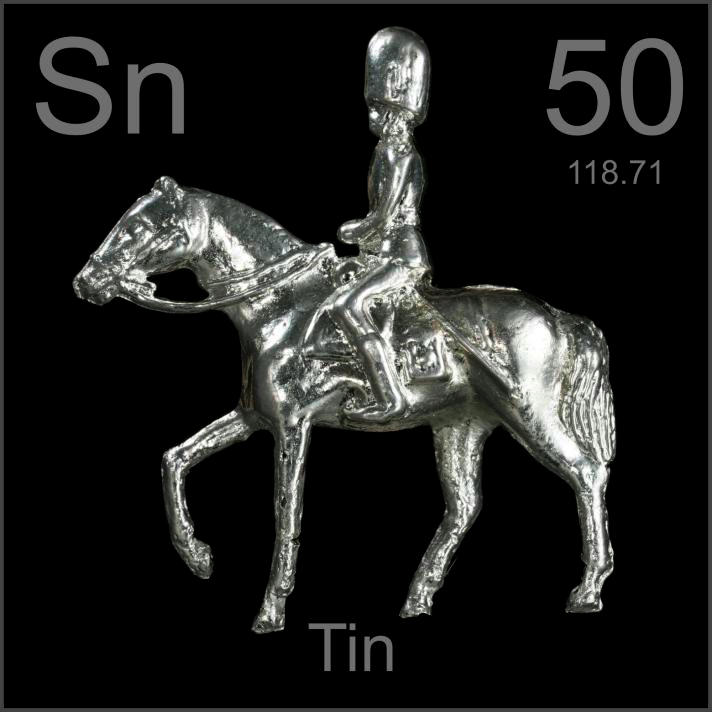
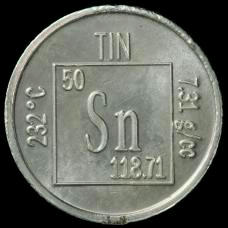
Metal Report: Tin

Tin:

Protons: 50
Neutrons: 69
Electrons: 50
Atomic Mass: 119

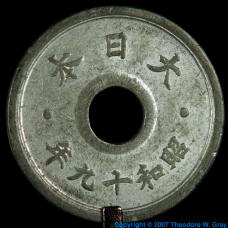
History: Tin use can be dated back to the Bronze Age (around 3000 BC), since it used in the production of bronze with copper. The earliest evidence of tin mining is from Europe, in Brittany, Cornwall, Devon, and the Iberian Peninsula. The demand for tin reached a high during the Classical times, but then decreased during the Medieval period. Cornwall was the major tin producer during the Middle Ages, however that changed after large tin deposits were found in Bolivia and East Asia. In 1956 tin producers formed the International Tin Council to regulate the production of tin. Tin was once used to wrap food and drugs, but was replaced by aluminum foil (hence the term “tin foil”). Although many items are called “tin” they are now actually used with steel or aluminum.

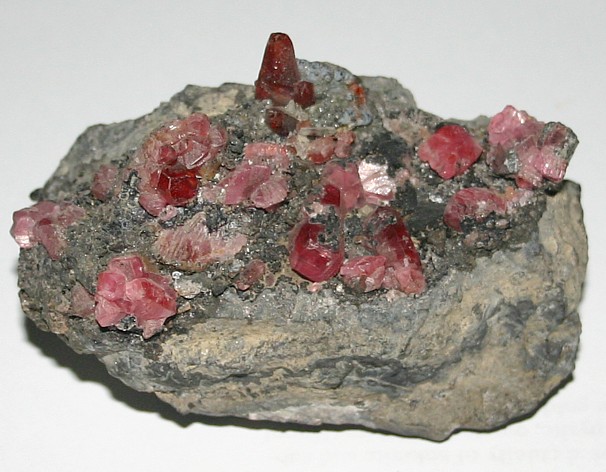
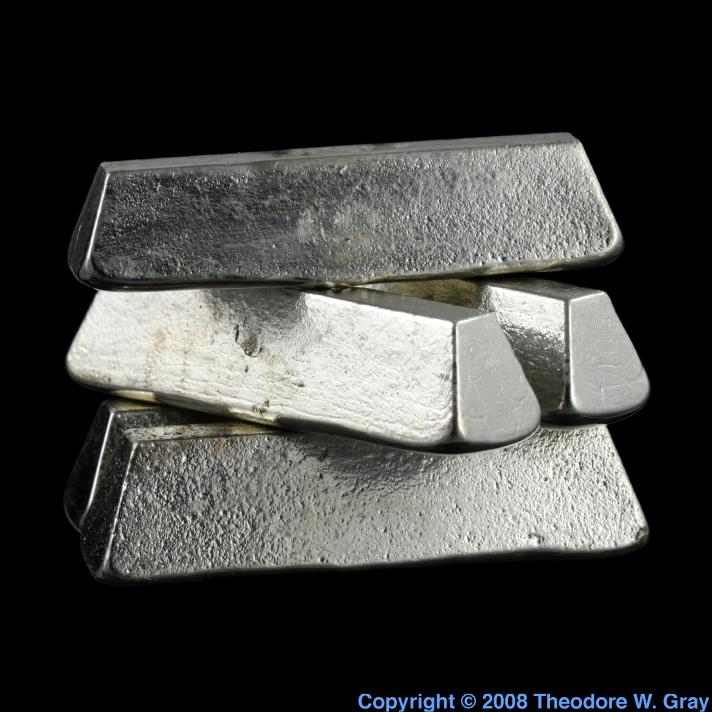
Characteristics: Tin is a silvery white metal that has a distorted diamond structure. It combines well with iron, and has 10 stable isotopes. In nature, it is rarely found free but as tin dioxide with mineral cassiterate. Tin can be reduced with coal. It does not appear to be an expensive metal, and its replacements could be due to a lack of it. It is found and mined mainly in Chinas, Malaysia, and Peru, in descending order. Tin also produces plenty of isotopes: bronze, pewter, solder (the most common use of tin), and spotted metal which is made when tin combines with lead but lead cools faster giving the metal a dappled effect. 


Properties: It is very soft and malleable, and is not easily oxidized. For this reason it is used to cot other metals to prevent corrosion. It has a melting point of 232°C, and a boiling point of 2270°C.


Uses: Tin is not toxic, so it is used in food packaging. Tin salts, which are toxic, are used to spray on glass for electrically conductive coatings. Molten is used to help produce float glass, which is used in windows. The most common tin salt, stannous fluoride, is used in toothpaste. Tin chloride is used in dying textiles and increasing the weight of silk. Also, tin replaces lead in some fishing weights.


Tin Cycle:
 0001292814-10-001853_X27X0.JPG.jpg
Sources: